


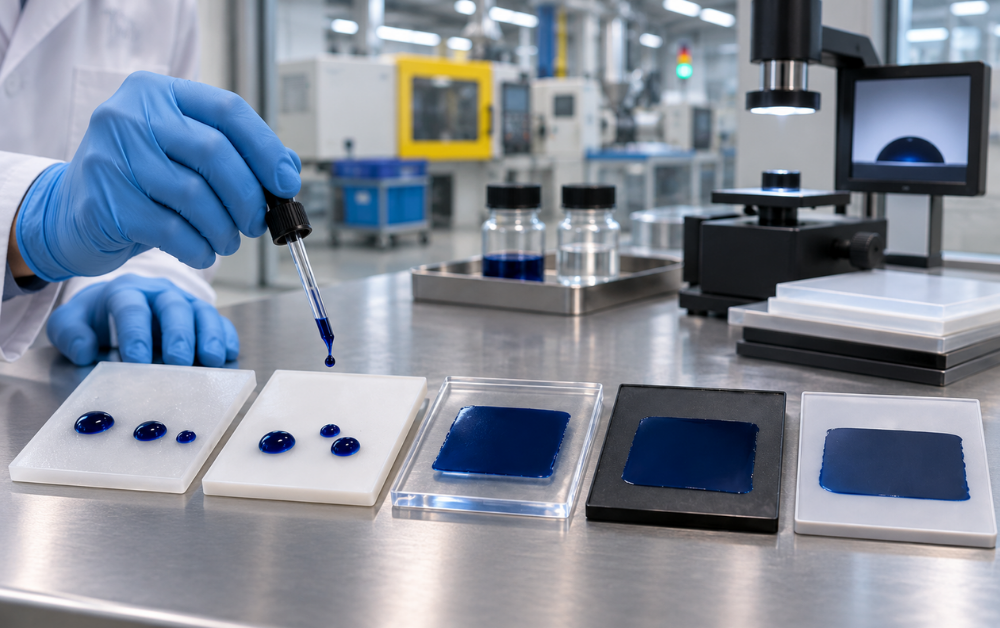
Quick answer: Sometimes. But "plastic" is too broad to answer on its own. Polypropylene and polyethylene are difficult because ink does not naturally wet them very well. Polycarbonate and ABS are usually easier from a wetting standpoint, but they can react badly to certain chemicals. Flexible PVC brings another issue entirely: plasticizers can move toward the surface over time and weaken a print that looked fine at first. The resin matters, and so does whatever is sitting on top of it.
"Will UV ink stick to plastic?"
We get that question a lot.
The problem is that plastic is not one material. Polypropylene, polyethylene, ABS, polycarbonate, PVC, and acrylic may all get grouped under the same word, but from an ink standpoint they can behave very differently. Two parts can look almost identical and still react completely differently when printed.
So the first question is not really whether UV ink sticks to plastic. It's what plastic we're talking about, and after that, what's actually on the surface.
Start With Surface Energy
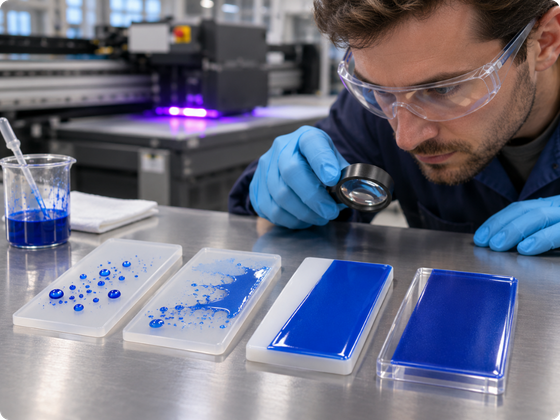
Some plastics are difficult before the ink ever reaches the cure stage. Polypropylene and polyethylene are good examples: their surface energy is naturally low, so liquid ink may bead up, pull back from the edges, or refuse to form an even film. If the ink is not wetting the surface properly, curing it harder is not going to fix the problem. You have to address the surface first.
Polycarbonate and ABS tend to wet more easily. That can make them simpler to print in some applications, but it does not mean they are problem-free.
PVC is less predictable. Rigid PVC sheet and flexible PVC material can behave nothing alike, because the chemistry and additive package can be very different. Calling both of them "PVC" does not tell you enough to predict adhesion.
A quick print test can reveal a lot. A surface-energy check can too. Either one is better than assuming a material should print a certain way because of its name.
The Resin May Not Be the Surface You're Printing On
This comes up constantly with molded parts. The part may be polypropylene, ABS, or polycarbonate, but the ink may actually be landing on mold-release residue, a slip additive, oil from handling, or something left behind during manufacturing.
Mold-release agents are especially troublesome: they're designed to make a molded part separate cleanly from the tool, which is useful in production and terrible for adhesion if residue is still on the surface when the part reaches the printer. Slip additives can create similar problems. So can protective films, fingerprints, cleaners, dust, and other residue.
And most of this is not obvious by looking at the part. A surface can appear spotless and still be difficult to print.
That is why the resin identification is only part of the story. The actual surface condition matters just as much.
Some Plastics Will Need Pretreatment
If you are printing on polypropylene or polyethylene, pretreatment is often part of the process. Flame, corona, and plasma treatment are commonly used to raise surface energy so the ink can wet the material more effectively, and a primer may also work depending on the application.
Which method makes sense depends on the part itself. A flat film moving through a web line is a very different problem from a three-dimensional molded component. Production speed matters. So does geometry, handling, and whether the treatment can be added without creating another bottleneck.
Not every plastic needs this. Some ABS and polycarbonate parts print well as received, and if testing shows good wetting and acceptable adhesion, there may be no reason to add another process step. That's worth checking before building pretreatment into production.
Plastic Can React to the Ink
This is where plastic gets more complicated than many metal applications. Sometimes the ink is not the thing that fails. The substrate does. Polycarbonate, for example, can be sensitive to certain chemicals and solvents, and under the wrong conditions, the surface may craze or develop fine stress cracks. A print could adhere well and still be unacceptable because the material underneath it has been damaged.
ABS has chemical sensitivities too, although the exact behavior can vary with the grade and formulation. That means compatibility testing needs to look at more than whether the ink sticks. You also need to make sure the part still looks and performs the way it should after printing and cleaning.
Flexible PVC Can Fail Later
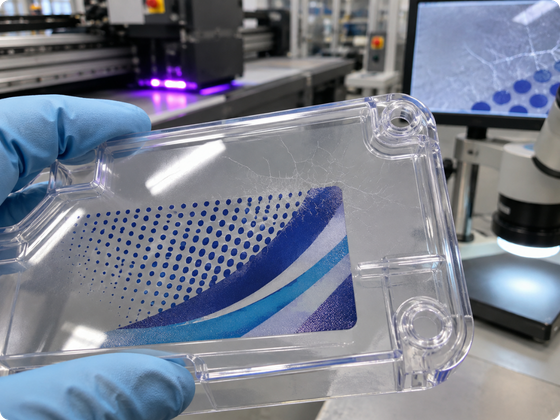
Flexible PVC deserves extra attention because it can create problems that do not show up right away. The material is often made flexible by adding plasticizers, and over time those plasticizers can migrate toward the surface. When that happens, they may interfere with the ink bond from underneath.
That can produce a frustrating result: the print passes an adhesion test today and begins lifting weeks or months later. A five-minute tape test will not catch that.
If flexible PVC is going into an application where long-term adhesion matters, the testing needs to reflect that. Aging, storage conditions, heat, and actual use can all become relevant.
Rigid PVC may behave very differently, so it should not automatically be treated the same way.
Test for What the Part Will Actually See
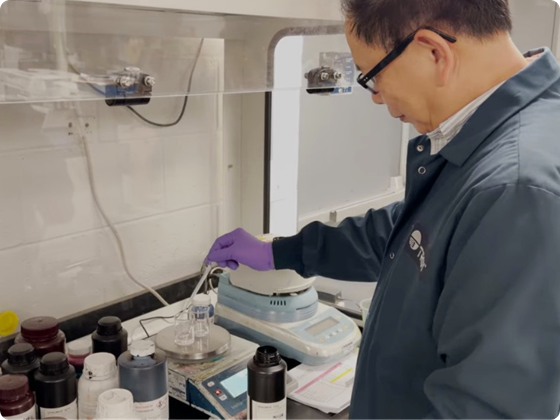
Getting the ink to stick is only the first step. What happens after printing matters just as much.
Does the part get bent during assembly? Does it live outdoors? Will someone wipe it down with alcohol or another cleaner? Is it handled constantly? Does the print rub against another surface during shipping? Those conditions should drive the testing
A print on an indoor electronic enclosure may only need to survive normal handling and occasional cleaning. A flexible part may need the ink film to bend repeatedly without cracking. Outdoor signage has to deal with sunlight, temperature changes, moisture, and weathering.
There is no useful universal test for "plastic durability." The test should match the part.
Treat Each Resin as Its Own Application
This is where a lot of printing problems begin. A company gets a good result on one plastic, then assumes the next plastic will behave the same way. It may not.
Polypropylene may need help just to get the ink to wet the surface. Polycarbonate may wet beautifully but react poorly to a solvent. ABS can vary depending on the grade, additives, and manufacturing process, and flexible PVC may print perfectly at first and create an adhesion problem later. Those are not minor differences. They affect the ink, pretreatment, cleaning method, cure settings, and test plan.
TROY is currently running structured adhesion and durability testing across polypropylene, polycarbonate, ABS, and PVC so we can build more specific guidance around each resin instead of treating plastic as one category.
When an Application Needs More Testing
Some plastic applications deserve a little more caution before moving into production. Outdoor use is one, and so is any application where the part bends, folds, or gets formed after printing.
The same goes for parts exposed to aggressive cleaners, solvents, oils, or other chemicals. Molded parts should be checked for release agents or other residue. Flexible PVC should be evaluated with longer-term adhesion in mind.
And if the only material available for testing is a generic plastic sheet, be careful about drawing conclusions from it. A production part may have a different coating, additive package, surface texture, or manufacturing history. None of that means the job cannot work. It just means a quick sample is not enough to answer the question.
Thinking About Printing Directly on Plastic?
Start by identifying the resin, then look at the surface condition, any coatings or additives, and what happens to the part after printing.
Those details tell you much more than the word "plastic" ever will.
Frequently Asked Questions
Does UV ink stick to every type of plastic?
No. Different plastics have different surface energy, chemistry, additives, and physical properties. Polypropylene, ABS, polycarbonate, and PVC may all require different ink, pretreatment, or testing.
Which plastics are most likely to need pretreatment?
Polypropylene and polyethylene are two of the most common. Their low surface energy makes wetting difficult, so flame, corona, plasma treatment, or a compatible primer may be needed. Other plastics sometimes print well without treatment; testing is the only reliable way to know.
Why would ink start peeling months after it was printed?
Flexible PVC is one place this can happen. Plasticizers inside the material can slowly move toward the surface and interfere with the ink bond over time. The initial print may look fine and pass a basic adhesion test, then begin failing later.
Do mold-release agents really affect printing?
They can. If residue remains on an injection-molded part, it may prevent the ink from bonding properly, and the part can still look completely clean. That's why cleaning and surface-condition checks are useful before blaming the ink.
Can UV ink damage plastic even if adhesion is good?
Yes. Some plastics, especially polycarbonate, can react to certain chemicals or solvents. The ink may adhere while the substrate develops crazing or stress cracking, which is why compatibility testing should look at the condition of the part as well as the ink film.
Related Posts
Will UV Ink Stick to Plastic? What Manufacturers Should Know
Quick answer: Sometimes. But "plastic" is too broad to answer on its own. Polypropylene and polyethylene are difficult because ink does not naturally wet them very well...
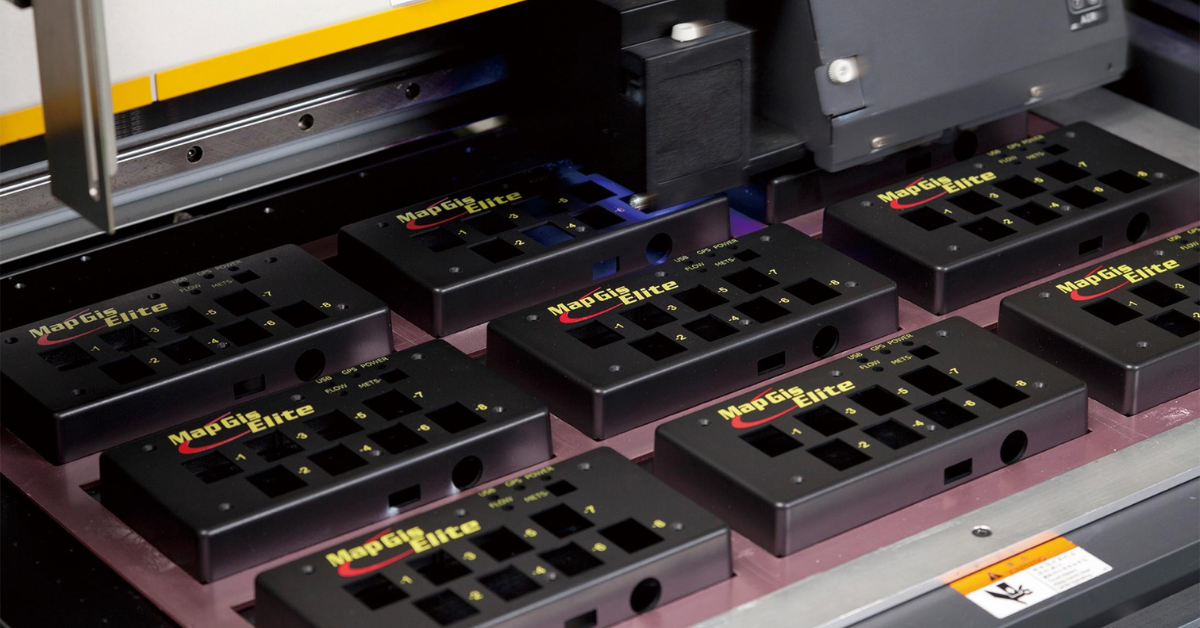
UV Printing on ABS Plastic: Two Paths, One Real Tradeoff
Quick answer: TROY identified two reliable ways to get strong UV ink adhesion on ABS plastic, plasma treatment and precoating with TROY fluorescent blue ink. Both passed adhesion,..
Why Isn't My White Ink Opaque Enough?
Quick answer: Weak white ink opacity is rarely one thing. The most common causes are not enough ink laid down to fully block the substrate, pigment that's settled out of..
Leave a Reply