


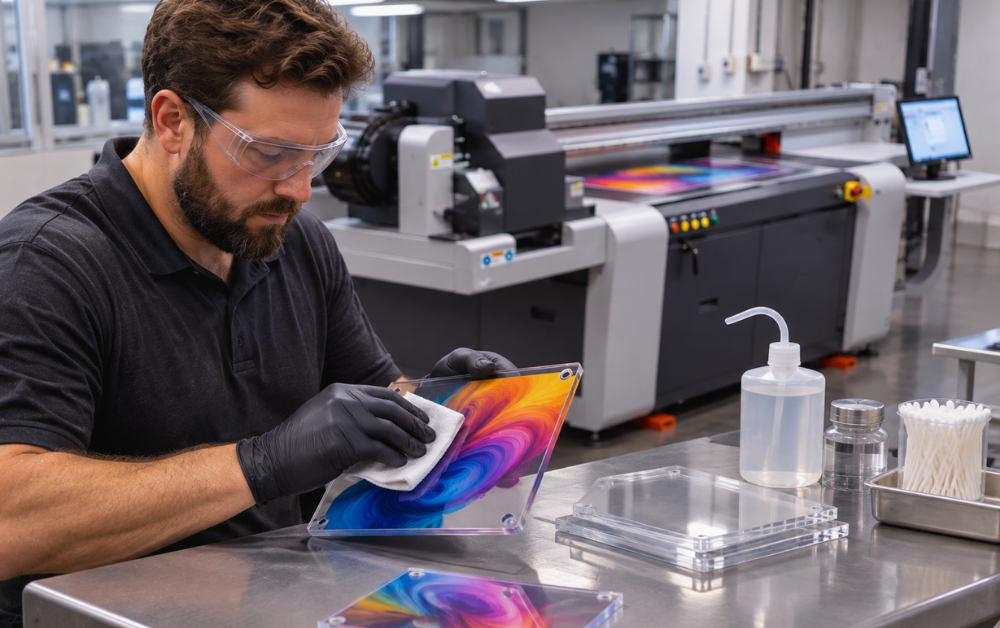
Quick answer: TROY identified a reliable way to get strong UV ink adhesion on clear polycarbonate: precoating with TROY fluorescent blue ink before the color print goes down. That approach passed adhesion, scratch resistance, and chemical resistance testing by a wide margin.
Printing directly onto untreated polycarbonate did not pass adhesion testing in this round, consistent with how most UV ink behaves on this substrate without a prepared surface. A plasma-treated sample also didn't pass, though the lab noted the treatment may not have been fully effective given the panel size.
Polycarbonate has a reputation for being an easier plastic to print on than something like polypropylene. It wets more readily. It doesn't fight the ink the same way a low-surface-energy resin does.
That reputation is only half the story.
TROY ran a structured adhesion test on clear polycarbonate sheet under three conditions. Precoating with TROY fluorescent blue ink was the clear winner, passing adhesion by a wide margin along with scratch resistance and chemical resistance.
Direct printing and plasma treatment, by contrast, didn't produce a passing adhesion result in this round of testing.
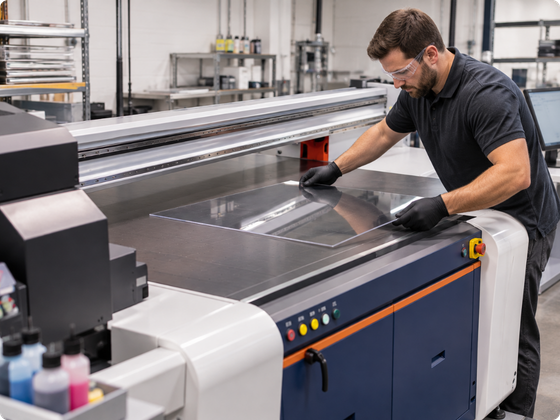
Direct Printing Didn't Hold
Ink printed straight onto untreated polycarbonate looked fine coming off the printer. Print quality was rated clean and uniform across every color channel.
Adhesion testing told a different story. Every sample scored a 0B under ASTM D3359, the lowest possible rating on that scale, well short of the 3B threshold TROY uses as its standard. The print looked complete and cured normally. It just didn't bond to the surface.
Plasma Treatment Didn't Fix It, But the Test Has a Caveat
A second sample was plasma treated before printing, the standard method for raising a plastic's surface energy so ink wets and bonds more readily. Adhesion still failed at 0B.
That result comes with a real limitation attached. The panel used for this test was large enough that the lab noted effective, even plasma treatment across the full surface wasn't guaranteed by the equipment available.
This test doesn't confirm that plasma treatment fails on polycarbonate as a rule. It confirms that in this specific run, on this specific panel, plasma treatment didn't produce a passing result, and the lab flagged its own uncertainty about whether the treatment was fully effective in the first place.
Precoating Was the Difference
The third sample was printed over a layer of TROY fluorescent blue ink, applied first as an undercoat, with the full color print going down on top of it.
That sample passed adhesion at 4B, close to the top of the ASTM D3359 scale and well clear of TROY's 3B threshold. It also passed scratch resistance, rated H and 2H against an H+ requirement under ASTM D3363, and chemical resistance, rated "great" under ASTM D5402 testing with isopropyl alcohol, meaning no ink dissolved off the surface after ten swipes.
Three different tests, three passing results, on the same treatment approach.
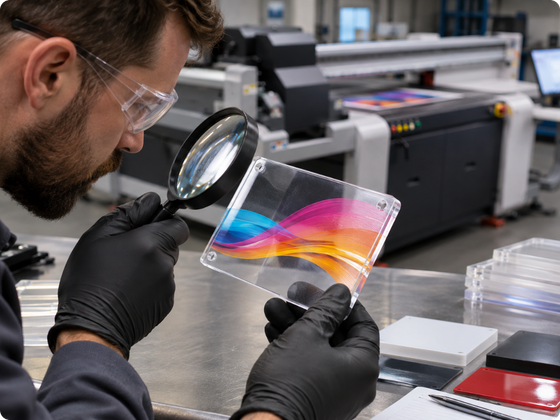
What This Actually Means for an Application
This is not a universal fix for printing on polycarbonate. It's a specific finding: on this clear polycarbonate sheet, adhesion depends on precoating with TROY fluorescent blue first, and direct or plasma-treated printing did not meet TROY's adhesion standard in this testing.
It also comes with a real tradeoff worth understanding before it factors into a design. A fluorescent blue undercoat is not invisible. Precoating the surface changes the finished look of the part, and it works against one of the main reasons polycarbonate gets chosen in the first place: optical clarity.
An application that needs to stay clear or see-through underneath the print isn't a fit for this approach. An application where the print sits on an opaque background, or where the undercoat color can be accounted for in the design, is a different conversation.
This finding also only applies to the clear polycarbonate sheet tested, under the conditions in this report. It doesn't extend to tinted, textured, or structurally different polycarbonate products without its own testing.
What Wasn't Tested
This round of testing measured adhesion, scratch resistance, and short-term chemical resistance under lab conditions. It did not test outdoor exposure, long-term weathering, UV stability over time, or performance outside a controlled environment.
None of that is implied by these results, and none of it should be assumed without its own validation.
Considering a Polycarbonate Application?
Polycarbonate isn't a simple substrate just because it wets easily. Whether direct printing, surface treatment, or an undercoat approach is the right path depends on the specific part, the finish requirements, and what the application needs to survive.
Frequently Asked Questions
Does UV ink stick to polycarbonate without any surface preparation?
Not in TROY's testing. Ink printed directly onto untreated clear polycarbonate failed adhesion testing completely, even though the print itself looked clean and fully cured.
Does plasma treatment solve adhesion on polycarbonate?
In this specific test, plasma treatment did not produce a passing result, but the test panel's size may have limited how evenly the treatment was applied. This isn't a confirmed verdict on plasma treatment for polycarbonate generally, more testing would be needed to separate the treatment method from the equipment limitation.
What actually worked in testing?
Printing a TROY fluorescent blue layer first, then the color print on top of it, passed adhesion, scratch resistance, and chemical resistance testing on the polycarbonate sheet used in this evaluation.
Does this approach work if I need a clear or see-through finish?
No. The undercoat is a visible, colored layer, and it changes the appearance of the finished part. This approach fits applications where the print sits against an opaque background, not ones relying on polycarbonate's natural clarity.
Is this approved for outdoor or long-term use?
Not based on this testing. These results cover adhesion, scratch, and short-term chemical resistance in a lab setting only. Outdoor exposure and long-term weathering would require separate, dedicated testing.
Related Posts
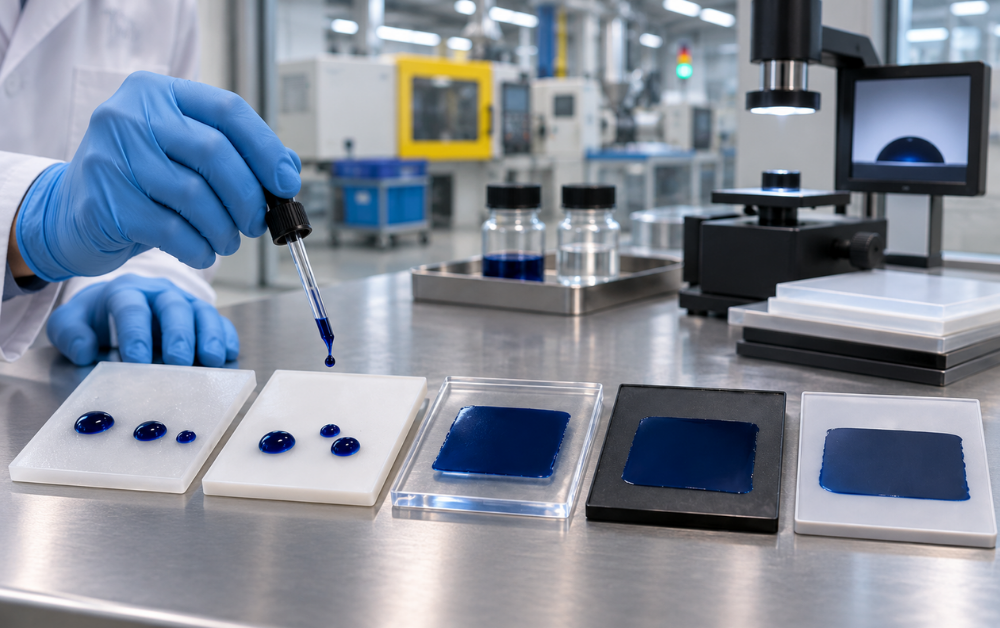
Will UV Ink Stick to Plastic? What Manufacturers Should Know
Quick answer: Sometimes. But "plastic" is too broad to answer on its own. Polypropylene and polyethylene are difficult because ink does not naturally wet them very well...
UV Printing on ABS Plastic: Two Paths, One Real Tradeoff
Quick answer: TROY identified two reliable ways to get strong UV ink adhesion on ABS plastic, plasma treatment and precoating with TROY fluorescent blue ink. Both passed adhesion,..
Leave a Reply