


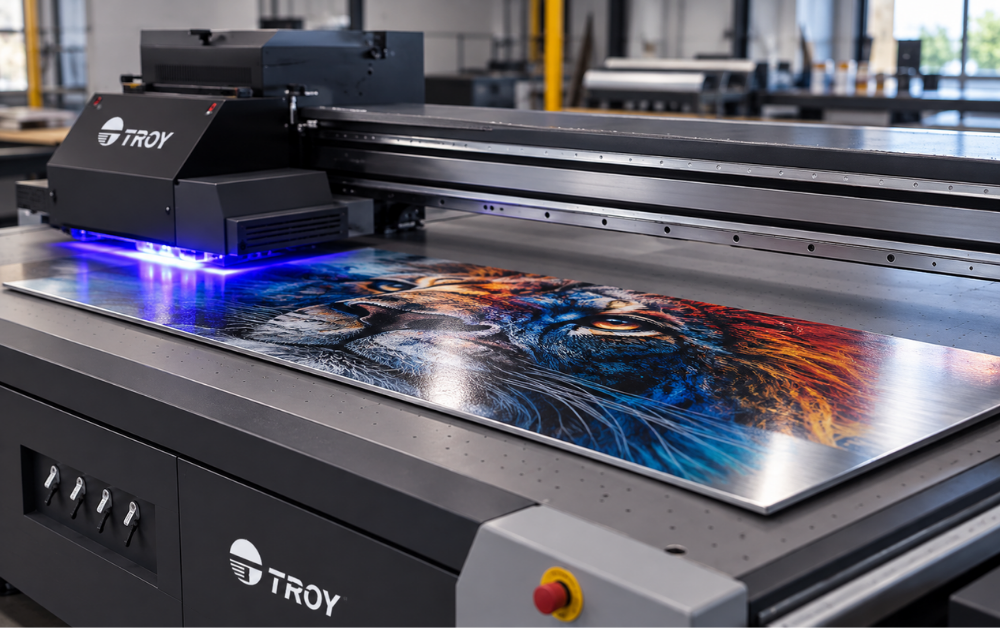
Quick answer: Sometimes. UV ink can adhere well to metal, but whether it does depends on the surface (raw, coated, anodized), how that surface was prepped, the cure conditions, and what the part has to survive afterward. Metal doesn't absorb ink the way porous materials do, so adhesion has to be tested, not assumed.
People ask this question expecting a yes or no.
The honest answer is neither. It depends on the surface the ink actually touches, how that surface was prepared, whether the ink cures and wets correctly, and what the part needs to hold up against once it leaves the printer.
Metal printing opens up real opportunities: product ID, control panels, nameplates, warning labels, asset tags, packaging prototypes, decorative parts. But metal doesn't forgive shortcuts. A print that looks great the moment it comes off the press can still fail months later if nobody checked adhesion, scratch resistance, or chemical exposure against what the part actually needs to survive.
Metal Isn't Built to Help Ink Stick
Porous materials give ink somewhere to go: small gaps to soak into, texture to grip. Metal gives it almost nothing. Combine that with low surface energy, which a lot of metals have, and wetting becomes the first problem, before cure even enters the picture.
When wetting fails, ink beads. It pulls back. It forms a film that's already unstable before a UV lamp ever touches it. At that point the question isn't whether the ink can sit on the metal. It's whether the ink can form a film stable enough to bond to anything at all.
That's why metal printing needs to be evaluated application by application. Some jobs work with the right ink, prep, and cure settings. Others need a base coating or custom formulation. Some aren't a fit until something in the process changes.
The Metal You See Usually Isn't the Metal the Ink Touches
Bare metal is rare on a production floor. What the ink actually meets is paint, primer, an anodized layer, a protective coating, wax, or a temporary production layer that was never meant to be permanent.
A raw steel panel, a painted steel panel, an anodized aluminum part, and a coated aluminum enclosure: four different print applications that might look identical sitting next to each other. Knowing which one you actually have matters more than knowing it's "metal." Bond to the wrong layer, and the print can look fine at first and fail the moment that layer releases, wears off, or reacts badly to handling.
Surface Condition Decides More Than People Expect
Dust, oil, fingerprints, silicone, forming residue, lot-to-lot variation: any of these can sit on a part that looks perfectly clean and still wreck adhesion. Ink bonds to whatever's actually there, not to the clean version everyone assumes is underneath.
Light contamination might just need a wipe-down. Heavier or less obvious contamination might need solvent cleaning, a surface-energy check, or pretreatment. Either way, surface condition is often the single biggest variable in whether adhesion holds, more so than the ink itself.
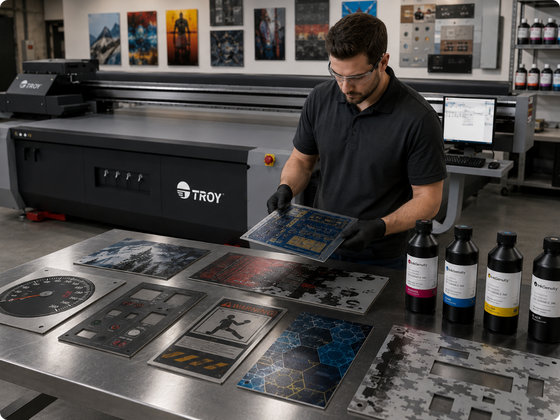
Pretreatment Should Solve a Problem, Not Just Exist
Solvent cleaning, plasma or corona or flame treatment, a compatible primer: none of these should be automatic. They're worth running when adhesion is actually poor, when surface energy is low, or when a coating or residue is getting in the way. If the surface already wets and bonds fine, adding a pretreatment step just adds cost.
Cure and Adhesion Are Two Different Questions
Cure hardens the ink film. Adhesion is whether that hardened film stays attached to whatever's underneath it. An under-cured ink stays soft and scratches easily, sure, but a fully cured print can still have almost no bond strength. Feeling dry and looking finished doesn't prove anything about adhesion. Both have to be checked separately.
Passing the First Test Doesn't Mean the Job Is Done
A tape-pull or cross-hatch test tells you whether the ink is bonding at all. It's a useful first screen. It's not the whole answer.
Once basic adhesion clears, the real test depends on what the part actually goes through: scratch, abrasion, chemical or solvent exposure, flexing after printing, color performance, barcode readability. The question was never really "does it stick." It's "does it survive what this part is actually going to see."
.png?width=560&height=420&name=Quality%20Control%20at%20the%20Print%20Bench%20(1).png)
Know What You're Testing For Before You Test
There's no single standard for metal printing. An indoor label, a control panel, and a chemical container all have different jobs to do, and testing needs to start from what the specific part has to survive, not a generic checklist.
For the fuller rundown of what to define and what to send before testing, see How to Prepare for an Ink and Substrate Application Review. The short version for metal: know whether the surface is raw or coated, andsend a real production part whenever you can. A sample that performs on a clean panel doesn't guarantee anything about a part carrying its actual coating and handling history.
When Metal Printing Is Worth a Closer Look
Short runs, variable graphics, product ID, control panels, warning and instructional marks, nameplates, asset tags, prototype packaging, security or specialty decoration, or replacing labels, decals, or an outsourced step: these are all places direct metal printing tends to earn its keep. Fit comes down to substrate, surface condition, requirements, equipment, and the economics of the whole thing. Adhesion alone doesn't make an application worth pursuing. A repeatable production advantage does.
When to Slow Down
Slow down, not stop, when outdoor exposure is required and weatherability hasn't been checked; the part gets bent, stretched, or formed after printing; the surface has wax or a removable coating; harsh chemical resistance is on the table; the coating itself is unknown or inconsistent; production-intent samples aren't available yet; or the customer's equipment and service agreement limit what's even possible.
None of that rules an application out. It just means the testing needs to be honest before anyone commits to production.
Thinking About Printing Directly on Metal?
Start with a real application review before assuming an answer either way. The surface, the coating, and what the part has to survive matter more than the metal type alone.
Frequently Asked Questions
Will UV ink stick to any metal?
Not automatically. It depends on whether the surface is raw or coated, its surface energy, how it was prepped, and the cure conditions. Metal doesn't give ink a way to mechanically grip the way porous materials do, so adhesion gets tested, not assumed.
What's the difference between raw metal and anodized aluminum for printing?
They're different jobs entirely. Anodizing changes surface energy and texture compared to raw aluminum, and the ink bonds to that anodized layer, not the metal underneath it. The same logic applies to painted or primed metal.
Is a tape-pull test enough to know the ink will hold up?
It tells you the ink is bonding, and that's it. It says nothing about scratch, chemical, or flex performance. Once basic adhesion passes, testing needs to move to whatever the application actually demands.
When should I be cautious about metal printing?
When outdoor exposure hasn't been validated, the part gets formed after printing, the coating is unknown, harsh chemicals are involved, or you don't have a real production sample to test yet.
Related Posts
Will UV Ink Stick to Metal? What Manufacturers Should Know
Quick answer: Sometimes. UV ink can adhere well to metal, but whether it does depends on the surface (raw, coated, anodized), how that surface was prepped, the cure conditions,..
How to Prepare for an Ink and Substrate Application Review
Quick answer: Before asking for an industrial ink recommendation, gather the basics about the job. Know what substrate you're printing on, whether it has a coating or treatment,..
Why UV Ink Adhesion Fails on Difficult Substrates
Quick answer: When UV ink does not stick, there usually is not one simple cause. The problem may start with the surface itself. The ink may not wet it properly because of low..
Leave a Reply